

A review of Farrukh Shahab’s solo show at the Ejaz Art Gallery ‘Where the Jasmine sleeps.
Farrukh Shahab’s recent exhibition at Ejaz Art Gallery put forward a fascinating dialogue between impulse and introspection. As the artist himself notes, the works arose not from calculated intention, but from instinctive layering; splashes, drips, fragments of fashion magazines and through successive erasures and overlays, forms emerge: figures, birds, leaves that resemble memories lifted from the sensory clutter of contemporary life.
This process, described as one of ‘discovery’ rather than ‘construction’, reveals Shahab’s journey back to a raw, expressive approach he first explored in London decades ago. Encouraged by curator Muhammad Zeeshan, he revisits that experimental impulse with the maturity of a seasoned painter, resulting in layered compositions that feel both spontaneous and deeply reflective.
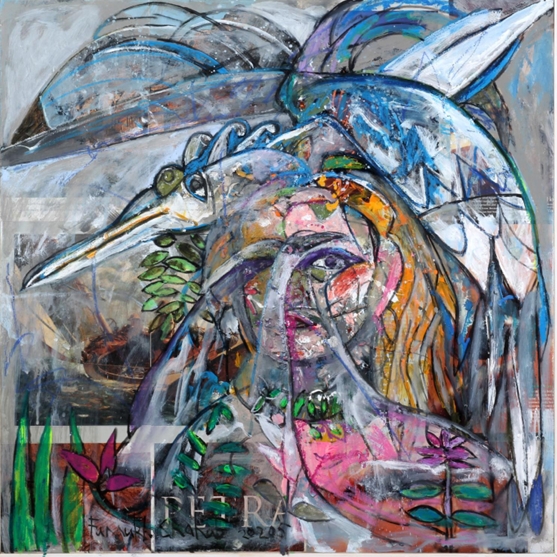
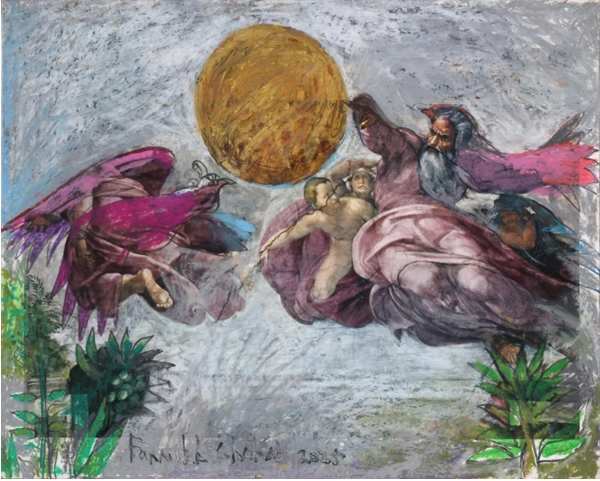
Zeeshan’s curatorial framing of these works underscores their deeper metaphoric resonance. The incorporation of media cutouts, imagery of desire, glamour and spectacle juxtaposed with expressive brushwork creates a palpable tension: seen vs concealed, seduction vs introspection. These layers are not merely formal experiments but metaphors for identity formation, spiritual seeking, and the navigation of the self amid a media-saturated culture.
That tension aligns with Shahab’s mature aesthetic: from his early portraiture (he earned a gold medal in the Sindh Artists’ Exhibition in 1990 and top honours in the Quaid‑i‑Azam Portrait Exhibition in 1995) through international exposure in Paris, London, and New York, to a current cross‑cultural idiom grounded in abstraction and memory.
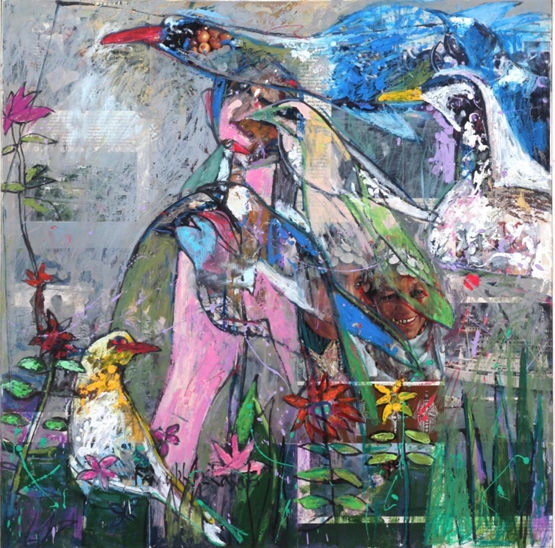
Across the exhibition, recurring motifs; birds, leaves, botanical shapes, ghostly human forms operate as quiet signifiers. They serve as anchors in Shahab’s dense, multimedia compositions: markers of memory, longing, renewal. These figures aren’t decorative, yet they function as thresholds or liminal spaces between spectacle and quietude, drawing viewers into subtle interior landscapes shaped by both collective imagery and individual longing.
Shahab’s birds, sometimes morphing into figure heads or echoing the gestures of human limbs, suggest not only psychological unease but also cultural echo: in Pakistan’s visual arts tradition, birds often signify freedom, spirituality, or poetic introspection; here, they straddle that symbolic history and a postmodern hybridity.
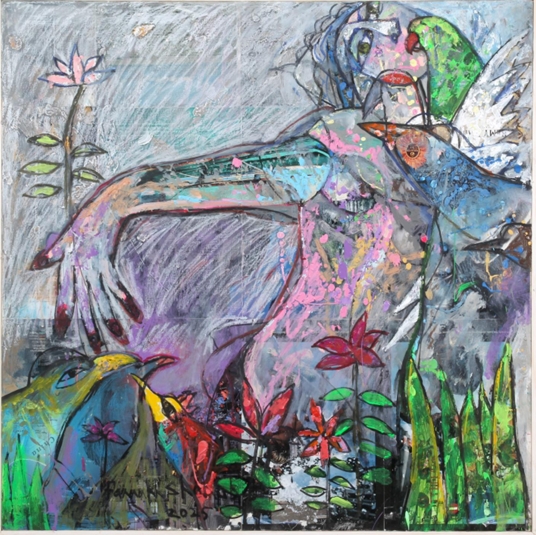
His Bird Series offers a chromatic animation, where birds and human profiles are entangled in visual play. The use of flora and Fauna alongside fragmented magazine textures comes out as an act of reclamation, a quiet protest against the synthetic and the airbrushed. In Bird Series 2, the woman’s face becomes a spectral center around which other beings orbit, simultaneously grounded and dissolving.
In Bird Series 8, the pink-toned figures evoke a sense of collective vulnerability, while the birds, almost secondary, flutter between presence and pattern. One can see the symbolic layering of the female form not just as an aesthetic choice, but as a cultural commentary: a recreation of the feminine within a patriarchal, hyper-visual society. In a Pakistani context, this layering of women’s bodies with flowers, birds, and consumer fragments evokes the tension between the domestic/spiritual ideal and the gaze of commodification.
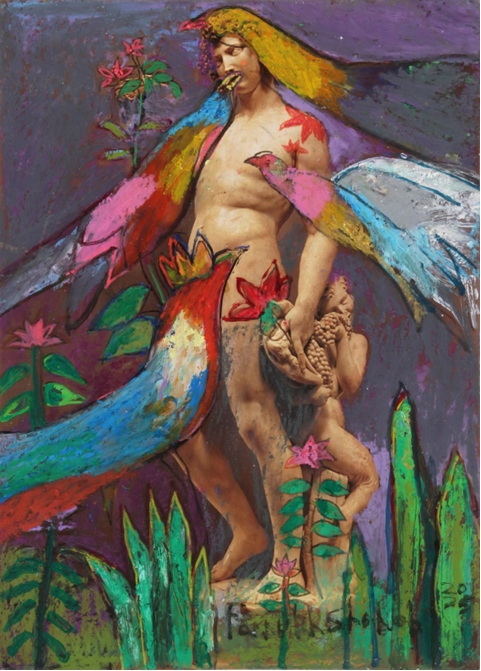
In South Asian visual traditions, particularly in Indo-Persian miniature painting, birds often symbolize the soul’s longing, divine messengers, or lovers in metaphor. Shahab’s birds, though, are neither strictly sacred nor decorative. They are fractured, abstracted, sometimes grotesque, aligned more with postmodern anxieties than Sufi transcendence. The small-scale Bird Series, executed on magazine paper, feel more raw, tactile, and immediate. Their silver-black palette gives them a nocturnal, almost cave-painting-like feel. The surface becomes a palimpsest; figures scratched and revealed rather than drawn. Here, birds are less decorative and more psychic: their presence looms over quiet, haunted faces. The botanical motifs (lotus-like flowers, small green stalks) return like soft, repeated mantras as attempts at grounding amidst visual disorientation.
This layered visual language echoes the hybrid traditions of Pakistani modernism, for example, the way Shakir Ali used birds in his cubist-inflected calligraphic works to evoke inner freedom within formal restraint.
Yet perhaps this tension is the point: to challenge viewers to find clarity within clutter, to listen where “the jasmine sleeps,” to confront the friction of the soul against a backdrop of mediated spectacle
Farrukh Shahab’s Bird Series is not just about birds, nor merely about collage. It is a meditation on seeing, and the difficulty of seeing clearly in a noisy, mediated world. These works are quiet yet unsettling, beautiful yet chaotic, layered both literally and symbolically.
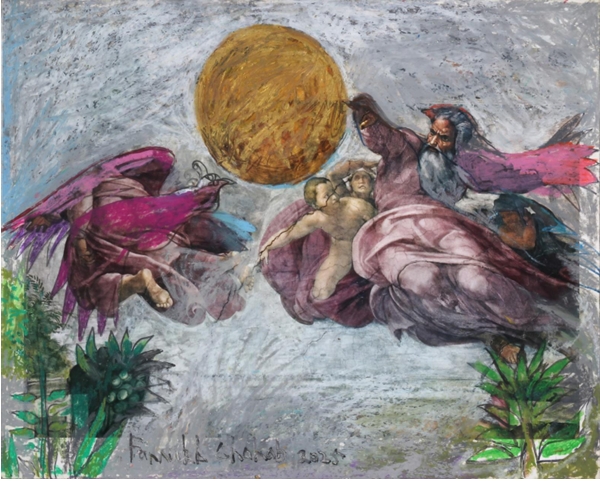
Shahab, with over thirty years of practice and formal recognition early in his career, has matured into an artist who embraces both cultural roots and a restless experimentation. His works at Ejaz Art Gallery reflect a dialectical tension between surface and spirit, anchored in memory, natural symbolism, media imagery, and painterly gesture. His canvases demand a slow, careful gaze: to look through the noise, to listen beneath the glamour, and to discover stillness amid spectacle. They ask for slow looking, for quiet listening.
And in that silence, perhaps, lies a jasmine still blooming.