
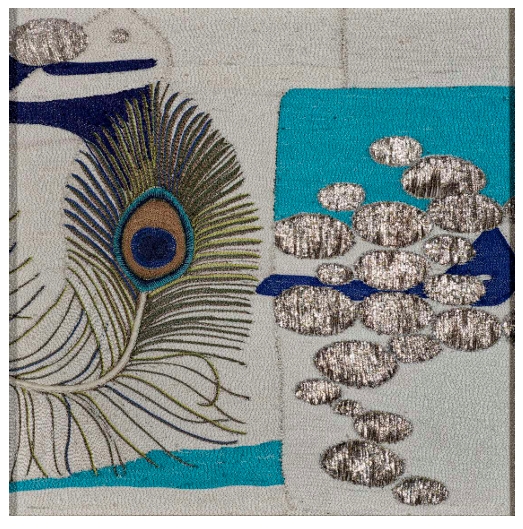
When I walked into Iram Zia Raja’s exhibition, the first thing I noticed was how calm it felt. Not empty, not minimal but just unhurried. Instead of announcing themselves loudly, the works waited. And that waiting and insistence on slow looking felt intentional. It immediately set the tone for how the exhibition wanted to be experienced: through attention, proximity and time.
The exhibition brings together jewelry and tapestries, two practices that are often separated by scale and function. Yet here, they felt like different chapters of the same experience. As someone deeply embedded in textile pedagogy at NCA, Iram seems less interested in categorizing objects than in tracing how form migrates and how a motif survives translation from metal to thread.
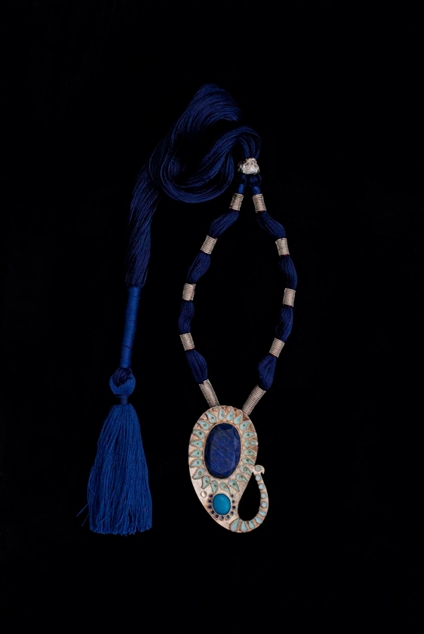
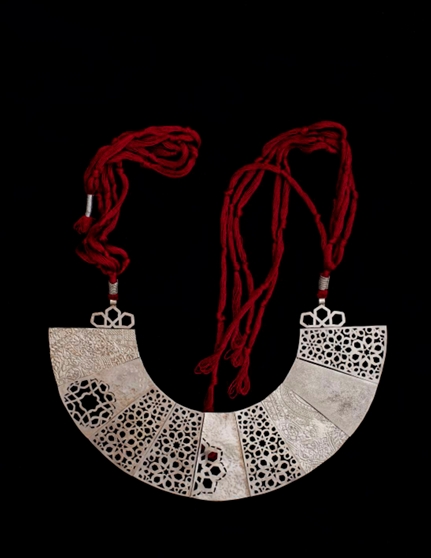
Her jewelry works operate at an intimate scale, but they carry a surprising conceptual weight. Pieces from the Finite Infinite series or Paisley as we know it, rely on recognizable ornamental vocabularies like paisley, islimi and geometry. But they are never merely decorative. What interested me was how these patterns resist closure. Forms elongate vertically, grids loosen, and symmetry is suggested rather than enforced. There’s a quiet tension between containment and expansion, as if the pattern is always on the verge of continuing beyond the object.
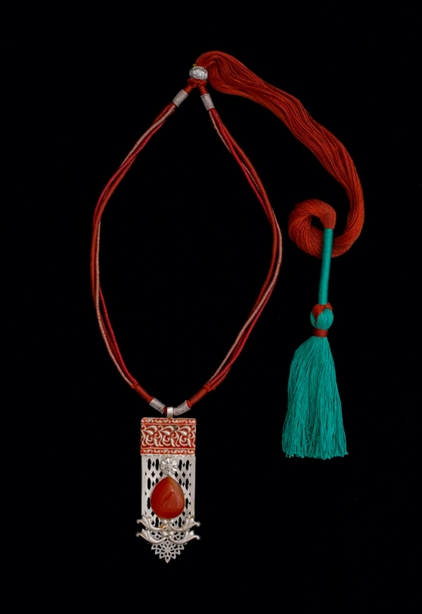
In Finite Infinite I, a pendant that at first glance appears deceptively simple, is composed in pure silver with filigree and meenakari. The square-like form feels stable and almost resolved. But the closer I looked, the more porous it became. The filigree opens the surface into a network of lines that refuse to settle into a single center. A similar idea is visible in Paisley as We Know It I, where Iram takes a motif that is deeply familiar within South Asian visual culture and rethinks its presence. The paisley here is elongated and vertically stretched. It is no longer a decorative filler but a central, almost architectural form. Set in lapis lazuli and turquoise, the color palette feels historical and nostalgic, yet the handling of the form is remarkably contemporary. I found this work particularly interesting in how it resists the commercial language often associated with jewelry. It doesn’t aim to embellish the body so much as converse with it.
Material choices play a crucial role in this reading. Filigree and repoussé emphasize line, outline and surface rather than solidity. Negative space is as active as metal, allowing light and shadow to complete the form. This feels significant because ornament here is structural, not additive. Iram treats pattern not as embellishment but as a system that holds memory, labor and knowledge within it.
The cords, made from cotton thread, tilla, dabka and copper wire, carry this logic further. They soften the authority of metal and pull the jewelry closer to textile traditions. In doing so, the pieces hover between categories; not quite jewelry in the commercial sense but not quite sculptural objects either. They feel wearable, but also archival. As if carrying traces of multiple temporalities at once such as past techniques, present bodies and future inheritances.
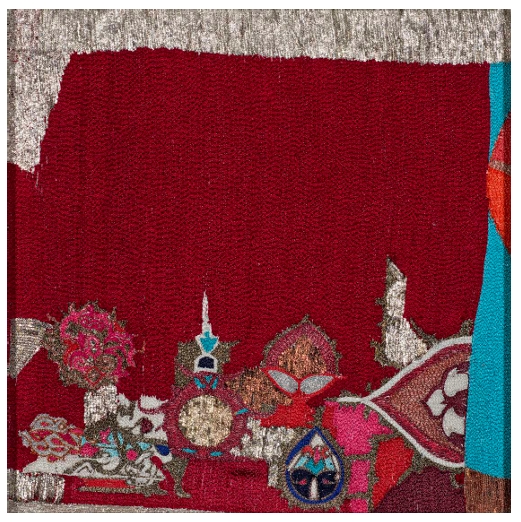
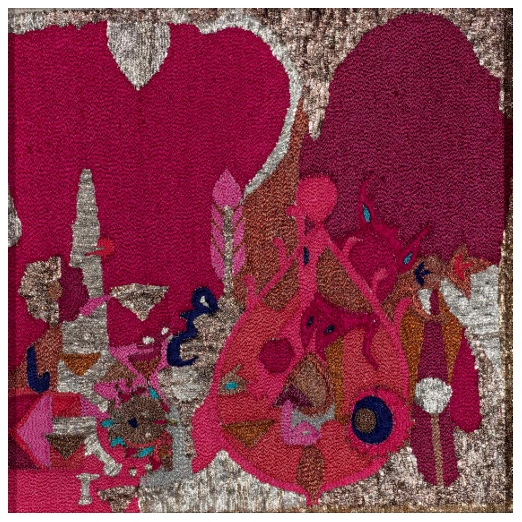
This idea of time becomes even more pronounced in the embroidered works. In the Patterns of Desire and A Thread in Time series, repetition takes center stage. But repetition here is more accumulative than mechanical. Each stitch carries slight variation, reminding the viewer that time in handwork is never uniform. I found myself thinking about how textiles record duration differently than images or objects. They do it through density, fatigue and rhythm rather than narrative.
Visually, these works sit somewhere between abstraction and ornament. From afar, they read as composed surfaces but up close the labor becomes legible. This wavering feels important. It puts merely viewing the pieces aside and instead foregrounds process, aligning the work with a slower and more embodied way of knowing. In that sense, Iram Zia Raja’s practice subtly challenges modern hierarchies that separate art from craft and concept from labor.
Together, these works reveal how Iram considers ornament as structure and tradition as an evolving system rather than inheritance. Whether in silver or thread, her patterns do not seek closure. They linger and extend, inviting continuation. They quietly remind us that making, like looking, is an act that is supposed to unfold over time.
What stayed with me after leaving the exhibition was how seamlessly the works moved across scales without losing their individuality. A pendant and a tapestry seemed to speak the same language where one whispers and the other murmurs. Iram Zia Raja does not present tradition as something fixed or complete but treats it as a living structure that is capable of adaptation without rupture. And so this exhibition felt less like a statement and more like a sustained reflection on form, on making and on how patterns remember us even as we continue to remake them.
The exhibition titled “Narratives of Form, Past and Present”, a solo presentation by Iram Zia Raja was displayed at Numaish Gah gallery in Lahore from January 18th to 27th 2026.