
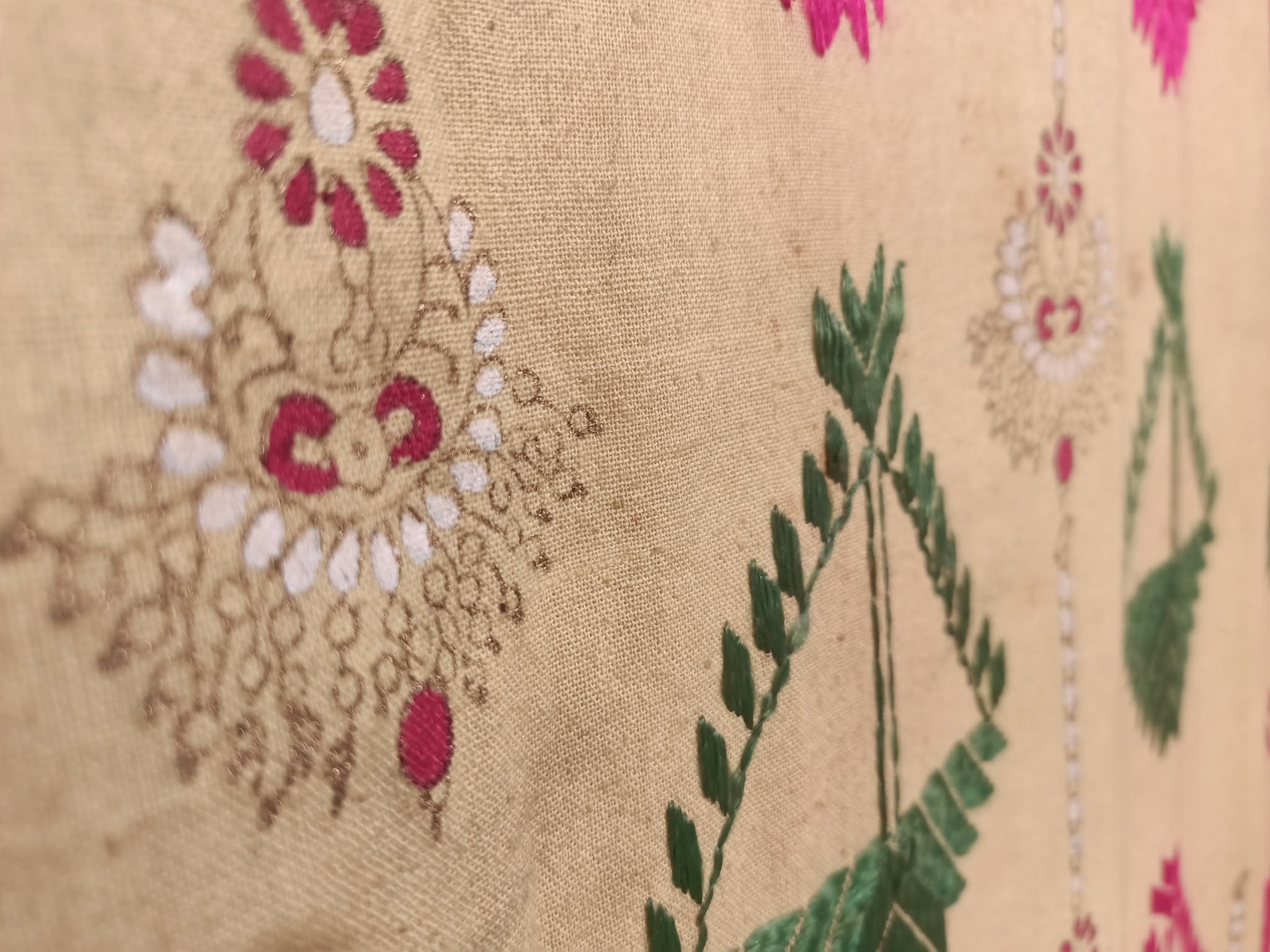
Tradition, as Michelle Maskiell reminds us, is never a static inheritance but a living construct—continuously reshaped by those who hold the power to represent it. Within this frame, Phulkari embroidery from Punjab emerges as far more than a dazzling interplay of colour and geometry. It is a living archive of women’s labour, creativity, and collective identity—stitched with memories that traverse generations, carrying the emotional and symbolic depth of an entire culture. Among South Asia’s most enduring textile legacies, Phulkari continues to weave together aesthetic ingenuity and gendered narratives that speak across centuries.
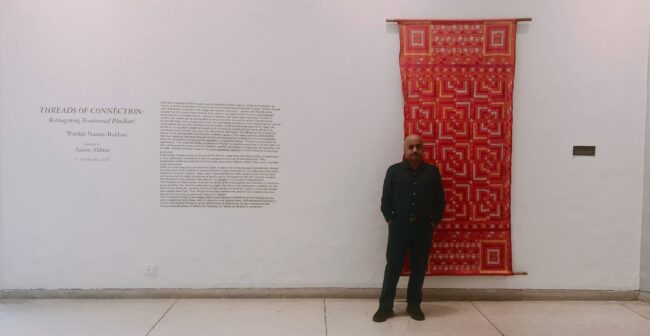
Wardah Naeem Bukhari’s solo exhibition Threads of Connection: Reimagining Traditional Phulkari, curated by Aasim Akhtar at Alhamra Art Gallery, is a profoundly evocative and scholarly meditation on Punjab’s iconic embroidery tradition. It transforms a domestic craft into a visual language of memory, resilience, and self-representation.
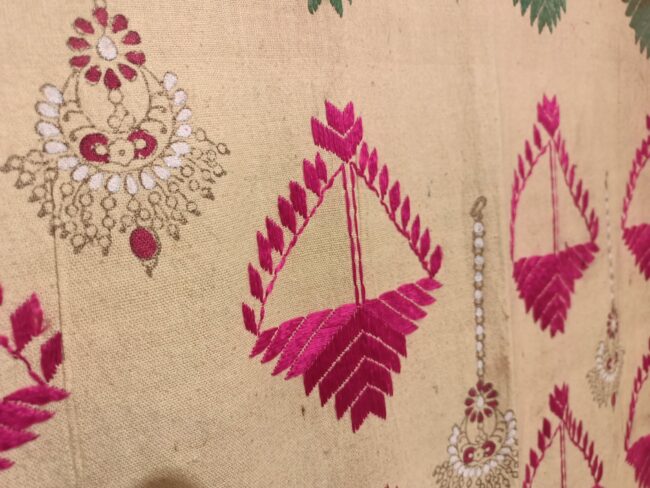
Rooted in extensive research and personal devotion, the artist’s practice honours the generations of women who infused their emotions, intellect, and social experience into Phulkari’s radiant threads. What began as a doctoral chapter evolved into a lifelong pursuit—collecting, documenting, and reinterpreting Phulkari textiles from across Pakistan. Each piece in the exhibition draws from Bukhari’s own collection, distinguished by the tactile beauty of handwoven khaddar, gleaming floss silk, and natural dyes that breathe with authenticity and ancestral aura.
Traditionally, Phulkari was created within intimate domestic spaces—courtyards where women embroidered shawls and dowry cloths while singing and storytelling. Every stitch was an act of care, a coded expression of affection, pride, and quiet defiance. These textiles are not only visual delights but chronicles of endurance, carrying the imprints of women’s lived worlds—of work, emotion, and imagination.
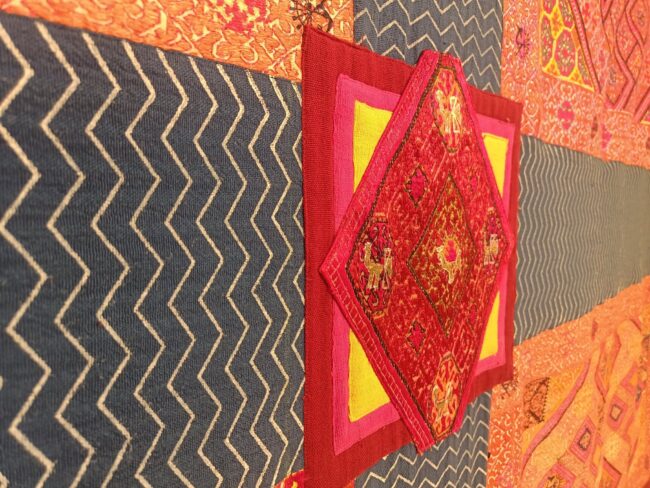
Bukhari’s work reclaims Phulkari as a profound visual and intellectual language. Her pieces reinterpret traditional forms—Bagh shawls and symbolic motifs—infused with a contemporary sensibility. Works such as Bailan Bagh and Ghunghat Bagh decode domestic symbols like rolling pins and forehead ornaments, transforming them into metaphors of nourishment, intimacy, and feminine strength. Similarly, Anar Bagh and Mor Bagh juxtapose fertility and beauty through lush imagery of pomegranates and peacocks, suggesting cycles of creation and continuity. Her Satrangi and Chahar Bagh, inspired by communal labour and the architecture of paradise gardens, celebrate the collective creativity of women who turned everyday life into poetry.
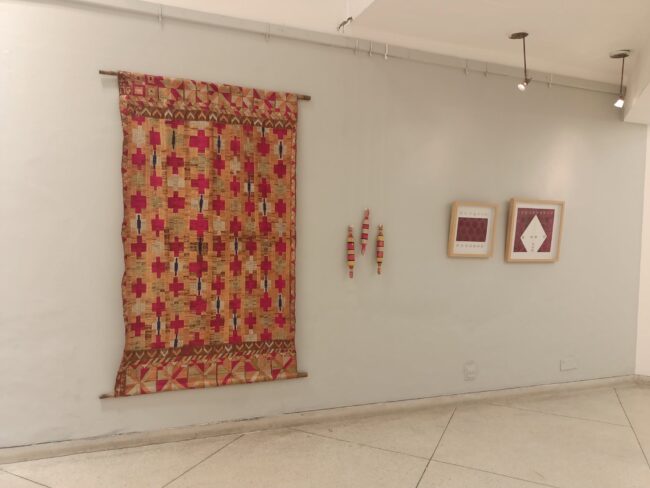
Under the mentorship of Sir Aasim Akhtar, Bukhari’s process—photographing original Phulkari textiles, translating motifs through block-carved wood, and reassembling them into new compositions—reveals a dialogue between preservation and innovation. The exhibition thus transcends nostalgia; it is not a return to tradition but its rebirth within contemporary consciousness.
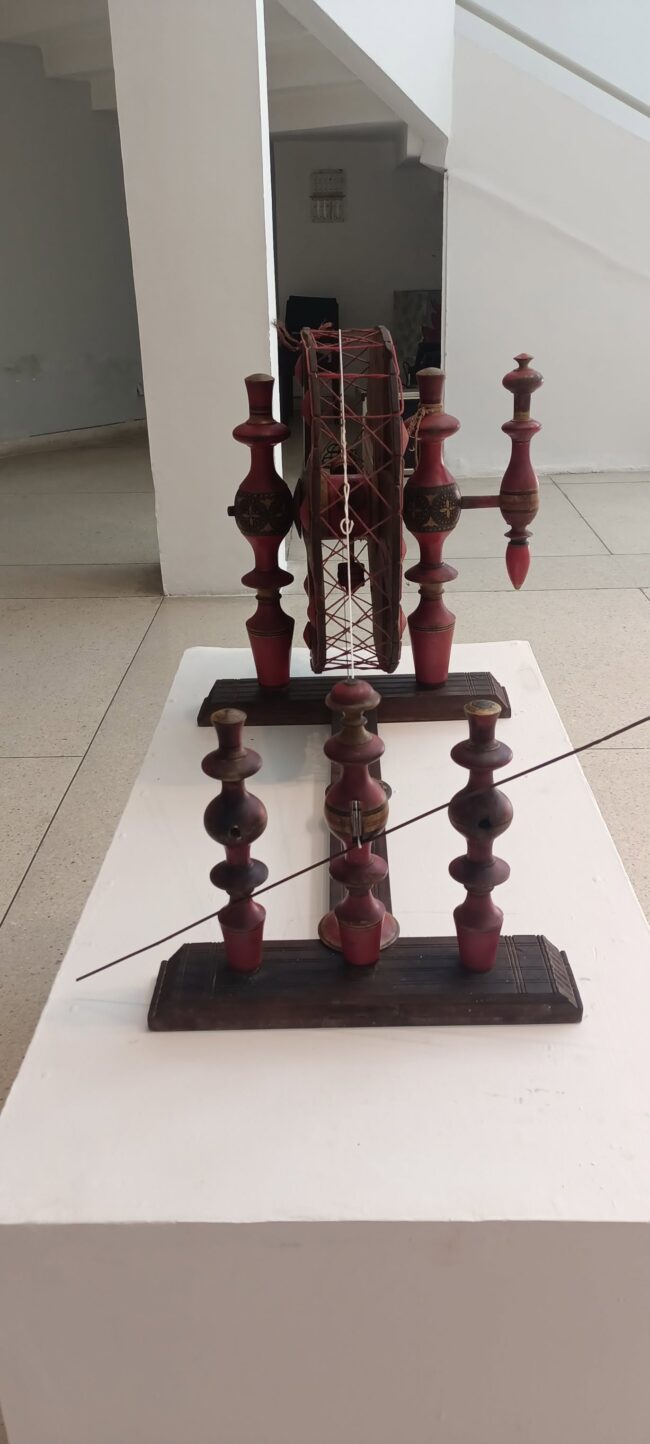
In an era governed by digital imagery and artificial intelligence, Threads of Connection reasserts the irreplaceable presence of the human hand. It celebrates patience, discipline, and the quiet brilliance of those who once counted threads by touch, creating worlds of meaning without sketches or machines. The exhibition is not merely an art show—it is an act of remembrance and revival, an elegy for the handmade, and a testament to women’s unbroken creative lineage.
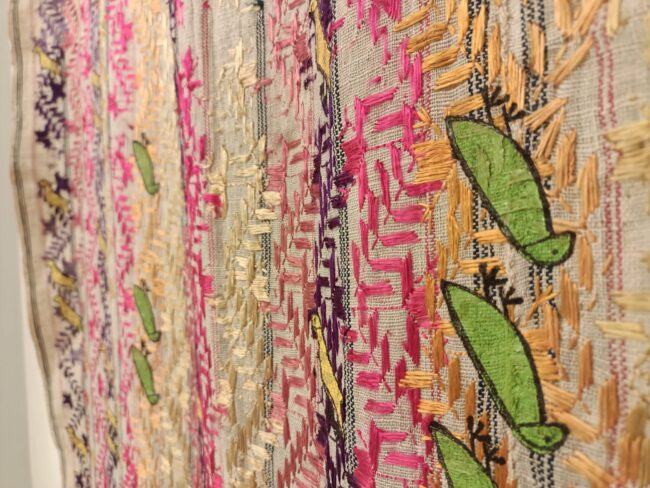
Through Between Memory and Modernity, Bukhari invites us to view Phulkari as both heritage and innovation—a living text of identity and imagination. Her work repositions the embroidered surface as a philosophical one, where memory and modernity, material and metaphor, converge. The exhibition is a reminder that art, like tradition itself, survives not by repetition but by renewal.
Mehjabeen Sarwar is an educationist and art writer based in Pakistan. Her work explores the intersections of art, craft and culture within South Asian artistic traditions.