
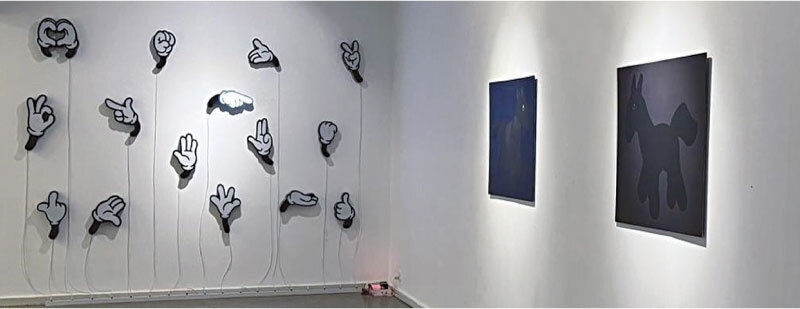
Adeel-uz-Zafar’s Over Rated / Under Rated interrogates how artistic value is constructed, circulated, and unevenly assigned within contemporary art systems.
Adeel-uz-Zafar’s solo exhibition Overrated/Underrated offers a compelling intervention into the contemporary logic through which artistic value is produced, circulated, and contested. The framing device, a binary lifted from the vocabulary of internet discourse, might initially seem flippant, but the artist mobilizes it with philosophical precision. Rather than accepting the binary as a cultural shorthand for taste, the exhibition treats it as a conceptual instrument capable of revealing the ideological forces that shape aesthetic judgment in the digital age.
The curatorial statement points to this cultural moment explicitly, describing how notions of being “overrated” or “underrated” infiltrate not only popular culture but the very mechanisms through which images achieve relevance or invisibility. Zafar’s work takes this as both provocation and problem: if contemporary audiences evaluate art through a metric of overexposure versus obscurity, then the artist’s task becomes one of interrogating that metric, turning its reductive logic back on itself.The artist’s longstanding practice, meticulously rendered, gauze-wrapped figures executed with a near-engraved precision, has itself entered the realm of recognizability that the exhibition critiques. These images, especially the Bunny and Teddy figures, have accrued cultural currency and collector demand, becoming icons within the local art market.
Zafar’s decision to subject these motifs to the overrated/underrated framework is a self-reflexive act not of self-flagellation but of analytical clarity. By designating Bunny as “underrated” despite its popularity, and Teddy as “overrated” despite its technical rigor, he unmoors value from demand, insisting that the discourse surrounding an artwork may obscure rather than illuminate its conceptual depth. This reversal destabilizes the assumption that an artwork’s status in cultural circulation reflects its intellectual stakes. Instead, the exhibition proposes that value is historically and economically contingent, shaped by the rhythms of visibility that govern what audiences repeatedly consume and what they fail to see.The introduction of new figures, among them a small wrapped creature with glowing dark eyes, and a set of ambiguous limb-like forms presented in serial panels, signals what the artist describes as “entropy,” an attempt to escape the gravitational pull of his own success.
These additions expand the symbolic lexicon of Zafar’s practice, interrupting the dominance of established motifs with forms that are less narratively anchored and less susceptible to sentimental identification. The circular portrait of the small creature, simultaneously vulnerable and enigmatic, operates at the threshold of recognition, withholding the ease of interpretation that the earlier characters sometimes induced. Its intimate scale creates affective proximity, but its identity remains suspended, resisting the tendencies of the rating economy to classify and rank. Likewise, the sequence of six distorted appendage-like sculptures on black panels offers a more radical withdrawal from legibility. Their bodily associations are present but unstable; they evoke gesture without narrative, presence without personality.
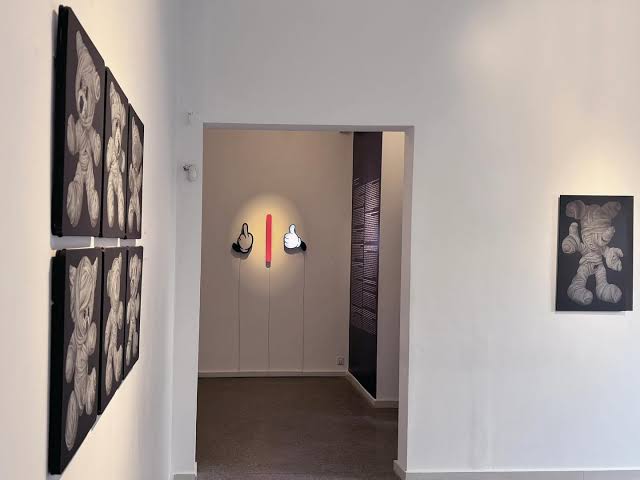
This ambiguity becomes a conceptual strategy, undermining the viewer’s impulse to declare them overrated or underrated by refusing the semantic cues that make such judgments coherent. In doing so, the works enact a quiet but pointed critique of how audiences, conditioned by digital culture, demand immediate readability from images.A crucial dimension of the exhibition is its explicit engagement with the economics of artistic labor. The artist openly acknowledges that commercially successful works sustain the production of more exploratory or personally meaningful ones. This transparency repositions the exhibition within debates about precarity, creative autonomy, and the market’s shaping force on artistic output. While the rating economy of the digital sphere may appear playful, Zafar suggests that its consequences are materially significant: artists are compelled to negotiate between their conceptual ambitions and the demands of collectors, institutions, and audiences whose preferences are influenced by cycles of visibility and trend. By foregrounding this tension rather than concealing it, the exhibition situates itself within a lineage of practices that challenge romanticized myths of artistic independence. It asks the viewer to recognize that the distribution of value is inseparable from the infrastructures through which art circulates.The exhibition’s intellectual force derives from the way it transforms a populist cultural phrase into a device for rethinking authorship, repetition, and aesthetic agency. By treating the overrated/underrated binary as an analytical tool, Zafar interrogates the conditions that produce consensus around artistic worth. Rather than offering a single narrative resolution, the exhibition inhabits a productive contradiction: it both participates in and critiques the economies of attention that shape contemporary image culture. The works do not simply illustrate the theme; they perform it. The new forms trouble the established ones, the ambiguous figures disturb expectations of recognizability, and the meticulous handling of each surface asserts a devotion to craft that resists the disposability implied by digital popularity metrics. In this way,
Overrated/Underrated becomes not merely a study of taste but a meditation on the fragile, contingent, and often paradoxical nature of value itself.What ultimately distinguishes the exhibition is the seriousness with which it treats its own premise. Instead of dismissing the rating vocabulary as superficial, Zafar recognizes that it has become a cultural technology, one that organizes perception, shapes markets, and influences artistic production. By situating his practice within this system and simultaneously challenging its logic, he offers a nuanced and intellectually grounded reflection on how images circulate and how meaning is assigned. The exhibition asks its viewers not only to reconsider their assumptions about what is overrated or underrated, but also to question why they feel compelled to assign such judgments at all. In doing so, it asserts that the work of art, far from being a passive object of evaluation, is an active agent in reshaping the frameworks through which we understand cultural worth.
Adeel uz Zafar (b.1975, Karachi, Pakistan) is an accomplished artist, illustrator, and author, that employs his insight as a children’s book illustrator into his practice—creating works where childlike imagery is granted a heaviness. The subject of his work, frequently children’s toys wrapped in bandages, raise questions about identity and the delusion of individuality. Identity concealed, the monstrous subjects of his works are then placed in front of a pitch-black backdrop, creating a striking visual impact. Uz Zafar’s meticulous attention to detail becomes even more impressive in the wake of the sheer size of his works.