

The IVS MPhil graduate, Fizza Saleem’s show unfolded with a variety of drawings, sketches, field notes, textures of bark and leaves and carefully gathered acts of devotion. The exhibition foregrounded processes of attention, repetition and listening. It embodied an investigation not into attunement: to land, to time and to the subtle ways meaning accrues through sustained presence. Central to the work was an engagement with Islamic mysticism, particularly the idea of the atom as a sacred point of resonance, a site where the divine and the material briefly touch. This cosmology offered a conceptual lens through which the exhibition’s fragments could be read. Small presences were treated as generative rather than marginal: a single leaf changing colour, a drop of water rippling across a pond. These gestures suggested that vast systems are often altered not through force, but through quiet shifts that require patience to perceive. The work resisted spectacle, asking instead for a slower, more contemplative mode of looking.
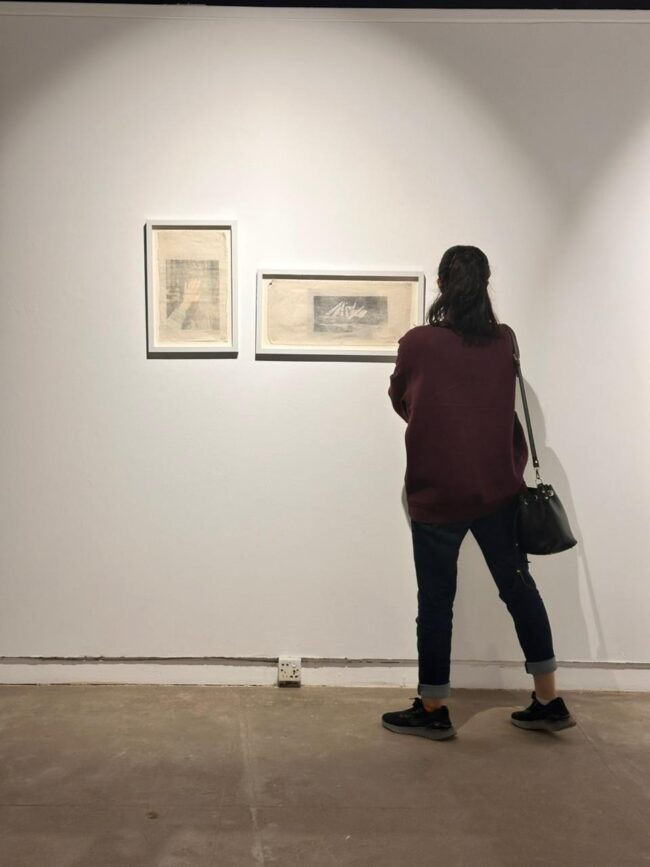
Drawing, within this framework, functioned as a practice of following. Lines appeared responsive rather than assertive, as though learning from the terrain they emerged alongside. The artist stayed with the drawing’s changes, allowing uncertainty, repetition and drift to remain visible. In doing so, drawing became a method of seeing differently, one that privileges receptivity over resolution.
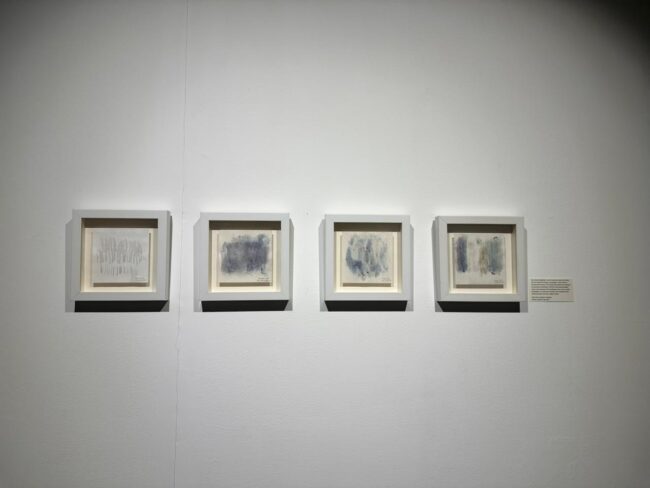
This ethic of attentiveness extended into the artist’s encounters with the forest. Standing among trees in silence, the artist describes a quiet but significant shift in perception, articulated as an unspoken recognition. This moment raised questions around reciprocity and perception: what does it mean to be present with the non-human without immediately translating that presence into language or use? The work gestures toward the invisible dimensions of human–nature interaction, where meaning is sensed rather than named.
.
Listening emerged as both a thematic concern and a methodological commitment. Framed as an act of care, listening was positioned as a return to attentiveness, to the land, but also to the embodied knowledge of those who dwell closest to it, such as farmers, foragers and storytellers. The exhibition subtly argued that preservation does not begin with intervention or documentation alone, but with connection. And connection, in turn, begins with listening, to stories, to silences and to forms of knowing that precede formal language.
One of the exhibition’s most compelling moments came through a personal anecdote embedded in the work. During a silent fast in the forest, the artist misplaced their tasbih counter and began recording each word of remembrance with ink on paper. What appeared as a practical substitution gradually transformed into something more profound. Remembrance ceased to function as a task measured in time and instead became a way of inhabiting time itself. This shift reframed devotion as a state of being sustained through attention rather than an act to perform.
The show resisted the logics of display and consumption that often govern institutional exhibitions. Its materials, fragile, partial, asked viewers to engage with what is often overlooked. By centering listening, devotion and attunement, the exhibition proposed an alternative way of relating to both art-making and the world: one rooted in care, reciprocity and the labour of staying with what unfolds.